Leta i den här bloggen

Visar inlägg med etikett NIDOVIRALES. Visa alla inlägg

lördag 31 december 2022

Hevosen koronaviruksen taxonominen sijainti: Betakoronavirus 1, Embecovirus


 https://www.ncbi.nlm.nih.gov/Taxonomy/Browser/wwwtax.cgi?mode=Undef&id=694003&lvl=3&keep=1&srchmode=1&unlock

Lineage (full)

Lisäys: Coronaviridae ryhmässä  Luokittelemattomissa koronaviruksissa UNCLASSIFIED CORONAVIRINAE  löytyy myös hevosen koronaviruslajia:

Equine coronavirus CH21

Taxonomy ID: 2861865 (for references in articles please use NCBI:txid2861865)
current name
Equine coronavirus CH21
NCBI BLAST name: viruses
Rank: species
Genetic code: Translation table 1 (Standard)
Lineage( full )
Viruses; Riboviria; Orthornavirae; Pisuviricota; Pisoniviricetes; Nidovirales; Cornidovirineae; Coronaviridae; Coronavirinae; unclassified Coronavirinae

fredag 13 mars 2020

SARS CoV Orf 1a

https://www.ncbi.nlm.nih.gov/protein/NP_828850.1

orf1a polyprotein (pp1a) [Severe acute respiratory syndrome-related coronavirus]

NCBI Reference Sequence: NP_828850.1

LOCUS       NP_828850               4382 aa            linear   VRL 13-AUG-2018
DEFINITION  orf1a polyprotein (pp1a) [Severe acute respiratory syndrome-related
            coronavirus].
ACCESSION   NP_828850
VERSION     NP_828850.1
DBLINK      BioProject: PRJNA485481
DBSOURCE    REFSEQ: accession NC_004718.3
KEYWORDS    RefSeq.
SOURCE      Severe acute respiratory syndrome-related coronavirus
  ORGANISM  Severe acute respiratory syndrome-related coronavirus
            Viruses; Riboviria; Nidovirales; Cornidovirineae; Coronaviridae;
            Orthocoronavirinae; Betacoronavirus; Sarbecovirus.
REFERENCE   1  (residues 1 to 4382)
  AUTHORS   He,R., Dobie,F., Ballantine,M., Leeson,A., Li,Y., Bastien,N.,
            Cutts,T., Andonov,A., Cao,J., Booth,T.F., Plummer,F.A., Tyler,S.,
            Baker,L. and Li,X.
  CONSRTM   BCCA Genome Sciences Centre, British Columbia Centre for Disease
            Control and National Microbiology Laboratory Canada
  TITLE     Analysis of multimerization of the SARS coronavirus nucleocapsid
            protein
  JOURNAL   Biochem. Biophys. Res. Commun. 316 (2), 476-483 (2004)
   PUBMED   15020242
REFERENCE   2  (residues 1 to 4382)
  AUTHORS   Snijder,E.J., Bredenbeek,P.J., Dobbe,J.C., Thiel,V., Ziebuhr,J.,
            Poon,L.L., Guan,Y., Rozanov,M., Spaan,W.J. and Gorbalenya,A.E.
  TITLE     Unique and conserved features of genome and proteome of
            SARS-coronavirus, an early split-off from the coronavirus group 2
            lineage
  JOURNAL   J. Mol. Biol. 331 (5), 991-1004 (2003)
   PUBMED   12927536
REFERENCE   3  (residues 1 to 4382)
  AUTHORS   Marra,M.A., Jones,S.J., Astell,C.R., Holt,R.A., Brooks-Wilson,A.,
            Butterfield,Y.S., Khattra,J., Asano,J.K., Barber,S.A., Chan,S.Y.,
            Cloutier,A., Coughlin,S.M., Freeman,D., Girn,N., Griffith,O.L.,
            Leach,S.R., Mayo,M., McDonald,H., Montgomery,S.B., Pandoh,P.K.,
            Petrescu,A.S., Robertson,A.G., Schein,J.E., Siddiqui,A.,
            Smailus,D.E., Stott,J.M., Yang,G.S., Plummer,F., Andonov,A.,
            Artsob,H., Bastien,N., Bernard,K., Booth,T.F., Bowness,D., Czub,M.,
            Drebot,M., Fernando,L., Flick,R., Garbutt,M., Gray,M., Grolla,A.,
            Jones,S., Feldmann,H., Meyers,A., Kabani,A., Li,Y., Normand,S.,
            Stroher,U., Tipples,G.A., Tyler,S., Vogrig,R., Ward,D., Watson,B.,
            Brunham,R.C., Krajden,M., Petric,M., Skowronski,D.M., Upton,C. and
            Roper,R.L.
  TITLE     The Genome sequence of the SARS-associated coronavirus
  JOURNAL   Science 300 (5624), 1399-1404 (2003)
   PUBMED   12730501
REFERENCE   4  (residues 1 to 4382)
  CONSRTM   NCBI Genome Project
  TITLE     Direct Submission
  JOURNAL   Submitted (31-AUG-2004) National Center for Biotechnology
            Information, NIH, Bethesda, MD 20894, USA
REFERENCE   5  (residues 1 to 4382)
  CONSRTM   BCCA Genome Sciences Centre, British Columbia Centre for Disease
            Control and National Microbiology Laboratory Canada
  TITLE     Direct Submission
  JOURNAL   Submitted (30-APR-2003) Genome Sciences Centre, British Columbia
            Cancer Research Centre, 600 West 10th Avenue, Vancouver, BC V5Z
            4E6, Canada
  REMARK    Sequence update by submitter
REFERENCE   6  (residues 1 to 4382)
  CONSRTM   BCCA Genome Sciences Centre, British Columbia Centre for Disease
            Control and National Microbiology Laboratory Canada
  TITLE     Direct Submission
  JOURNAL   Submitted (23-APR-2003) Genome Sciences Centre, British Columbia
            Cancer Research Centre, 600 West 10th Avenue, Vancouver, BC V5Z
            4E6, Canada
  REMARK    Sequence update by submitter
REFERENCE   7  (residues 1 to 4382)
  CONSRTM   BCCA Genome Sciences Centre, British Columbia Centre for Disease
            Control and National Microbiology Laboratory Canada
  TITLE     Direct Submission
  JOURNAL   Submitted (13-APR-2003) Genome Sciences Centre, British Columbia
            Cancer Research Centre, 600 West 10th Avenue, Vancouver, BC V5Z
            4E6, Canada
COMMENT     REVIEWED REFSEQ: This record has been curated by NCBI staff.
            The annotation in based mainly on the sequence analysis described
            by Snijder et al. (2003). Annotation of transcription regulatory
            sequences was copied from virtually identical (except the very 3'
            end) AY291315 (Frankfurt 1).  Designations of the 3'-adjacent genes
            do not coincide with those provided by Marra et al. (2003).
            Method: conceptual translation.
FEATURES             Location/Qualifiers
     source          1..4382
                     /organism="Severe acute respiratory syndrome-related
                     coronavirus"
                     /isolate="Tor2"
                     /isolation_source="patient #2 with severe acute
                     respiratory syndrome (SARS)"
                     /db_xref="taxon:694009"
                     /country="Canada: Toronto"
    

lördag 14 december 2013

NIDOVIRALES.Tarkkailtavat Coronavirukset. MERS-CoV

http://www.who.int/csr/don/2013_12_02/en/index.html
MERS-CoV  sai alkunsa kameleista ihmiseen .
http://www.who.int/csr/don/archive/disease/coronavirus_infections/en/index.html

NIDOVIRALES Coronaviruksista vuonna 2013. MERS- CoV mainitaan

http://www.ncbi.nlm.nih.gov/pubmed/?term=MERS-CoV+reservoir+host

 Vaikeaa  (S, severe) akuuttia (A, acute)   hengitystieoireyhtymää (R, respiratory , S, syndrome  aiheuttavaa koronavirusta (SARS CoV)  on jäljitetty tarkasti.  SARS-taapusten jälkeen  on viime aikoina ollut huomionkohteena toinen koronaviruskin:  Keski-Idässä (M, Middle, E, East)  on ilmennyt myös erästä  tällainen vaikeamuotoinen  hengitystieoireyhtymää  aiheuttavaa koronavirustulehdusta  ja sillä on nimi: MERS- COV: 

LÄHDE:
J Thorac Dis. 2013 Aug;5(Suppl 2):S118-21. doi: 10.3978/j.issn.2072-1439.2013.06.19. Tracing the SARS-coronavirus. Chan PK, Chan MC. SourceDepartment of Microbiology, The Chinese University of Hong Kong, Prince of Wales Hospital, Shatin, New Territories, Hong Kong Special Administrative Region, People's Republic of China.

TIIVISTELMÄ (Abstract)

  •  Ihmisisä esiintyy neljä endeemistä coronavirusta  ja ne ovat liittyneet lieviin  hengitystieinfektioihin. (Eihän ennen SARS- virusta  osattu edes odotaa coronaviruksista mitään vaaraa!) 
 Endeemiset coronavirukset ovat 
HCoV-229E
HCoV-OC43
HCoV-NL63
HCoV-HKU1
Vakavaa hengitystieoireyhtymää aiheuttavat coronavirukset ovat:
SARS-CoV
MERS-CoV

Four coronaviruses (HCoV-229E, HCoV-OC43, HCoV-NL63, HCoV-HKU1) are endemic in humans and mainly associated with mild respiratory illnesses; whereas the other two coronaviruses [Severe Acute Respiratory Syndrome Coronavirus (SARS-CoV) and Middle East Respiratory Syndrome Coronavirus (MERS-CoV)] present as emerging infections causing severe respiratory syndrome.
  •  CORONAVIRUKSET  tekevät evoluutiota  keräämällä pistemutaatioita ja rekombinoimalla genomista materiaansa  eri kantojen tai eri lajien kesken.
 Coronaviruses evolve by accumulation of point mutations and recombination of genomes among different strains or species.
  • Nisäkkäiten coronavirukset mukaan lukien ihmisen coronavirukset ovat  aikojen kuluessa evoloituneet lepakoiten coronaviruksista käsin.
Mammalian coronaviruses including those infect humans are evolved from bat coronaviruses. 
  •  Mitä tulee näihin  ihmiskunnalle uusiin viruksiin  SARS-CoV ja MERS-CoV,  ne ovat geneettisesti lähisukulaisia  lepakon coronavirusten kanssa, mutta  lepakkovirusten käyttämät  väli-isännät , osallistuvat todennäköisesti  virusinfektion  vahventamiseen ja  laajentamiseen  ja taudinvälittymiseen yli lajirajan.
While SARS-CoV and MERS-CoV are genetically closely related to bat coronaviruses, intermediate host(s) is (are) likely to be involved in the emergence and cross-species transmission of these novel human viruses. 
  •  Naamapalmusivettiilajista  ja  supikoirasta ruokatoreilta kerätyt näytteet ovat osoittaneet o niissä  suurta SARS-in kaltaisten virusten esiintymää   samoihin aikoihin kun ihmisillä  puhkeaa  SARS- tautia.  Mutta nämä eläimet  ovat pikemminkin  vaäliaikaisia satunnaisia isäntiä  kuin pinttyneitä reservoaareja.  . On tarvetta lisätutkimuksiin  coronavirusekologian  selvittämiseksi . Olisi tärkeää pitää valppaasti silmällä coronaviruksista ilmaantuvia  uusia viruksia, jotta  ne  tulisivat heti tunnistetuiksi. 
High prevalence of SARS-like coronaviruses have been found from masked palm civet cats and raccoon dogs collected from markets around the time of outbreaks in humans, but these animals are likely to be a transient accidental host rather than a persisting reservoir. More research is needed to elucidate the ecology of coronaviruses. Vigilance and surveillance should be maintained to promptly identify newly emerged coronaviruses.

Avainsanat, KEYWORDS:

Severe acute respiratory syndrome (SARS), animal reservoir, coronaviruses (CoV), evolution

NIDOVIRALES: Yllättävä pandeminen virus Coronaviruksista oli SARS-CoV 2003-2004

http://en.wikipedia.org/wiki/SARS_coronavirus

Wang L-E, Eaton BT. Bats, Civets and the Emergence  of SARS.
In: Wildlife and Emerging Zoonotic Disease: The Biology, Circumstances and Consequences of Cross-Species Transmission. 2007. Springer ISBN 978-3-540-70961-9

http://www.ncbi.nlm.nih.gov/pubmed/17848070

Alkuperäinen reservoaari ( Hr) löytyi lepakoista. BAT = lepakko; fladdermus.

Väliisäntänä, jossa infektio vahvistui, toimi  muutama eläin kuten  eräs sivettilaji jasupikoira.

Masked  Palm Civet,  Paguma larvata  Tämä on  sivettilaji. naamiopalmusivetti  ja sitä kasvatetaan farmeilla ja farmeilta viedään markkinoille lihaeläimenä. kauko-idässä, varsinkin E- Kiianssa.
http://en.wikipedia.org/wiki/Paguma_larvata
Ruotsalainen nimi on maskpalmmård.  Entinen suomalainen nimi oli naamaripalmunäätä.

Raccoon dog, Nyctereutes procyonoides  Tämä on suomeksi supikoira ja ruotsiksi mårdhund.
 http://en.wikipedia.org/wiki/Raccoon_dog

Näitä eläimia tuotiin markkinoille ja  henkilöt jotka olivat ammateissa, missä käsiteltiin  myytävää eläintä  tai näitten eäinten ruhoja,  saivat kontaktitartuntoja.   Tartunnalle  alttiiita eläimiä havaittiin tositakymmentä kuten rhesus apinat, makit,  afrikan vihreät apinat, kissat , ferretit, hiiret, jopa possu, hamsterit, marsut.

Alkuperäksi kuitenkin osoittautui lepakkolajit,  "hevosenkenkänokkainen" lepakko, hästskonäsan,  Horseshoe bat.
Esim. Kiinan  horseshoe bat, genus Rhinolopus sinicus , perhe Rhinolophidae, kantoi 39%:ssa  yksilöitä   geneettistä materiaalia, joka oli SARS-CoV kaltaista.  useita lepakkolajeja on tutkittu.  lepakoiten genomissa on  S- geenissä eräs 29nt- sekvenssi, joka deletoituu  viruksen adaptoituessa väli-isännissä  ja muuttuessa sitten myöhemmin helpommin ihmisestä toiseen siirtyväksi.

Lepakoita on hyvin paljon ja ne ovat monen viruksen reservoaari.Sitäpaitsi niitäkytetään kaukoidässä myös ravintona, jolloin pelkkä lepakon pyynti altista  lepakkoviruksille.  osa lepakoista on hedelmänsyöiä, joten virsuta voi tulla niiten puremista hedelmistäkin. 
 https://www.google.se/#q=roasted+bat

Ensimmäinen SARS purkauma oli  2002- 2003. Virus oli silloin hyvin patogeeninen
Toinen isompi purkautuma taopahtui 2003- 2004.

Vuonna  2003 identifioitiin SARS CoV reseptori ihmisessä. Se on metallopeptidaasi, angiotensiiniä konvertoiva entsyymi ACE2. Viruksen S- proteiini kiinnittyy  hanakasti ACE2 entsyymiin ihmislellä ja sivettieläimellä.

Ihmisestä ihmiseen tapahtunut tartunta 2003- 2004 oli tavattoman nopeaa. eräs  SARS CoV:lla infektoitunut lääkäri matkusti Kiinasta Hong Kongiin konferenssiin. Näin . yhdestä henkilöstä virus sitten levisi koko maailmaan   SSE tapauksina, superspeeding events, super nopeina leviämisinä-  hotellit, sairaalat ja lentomatkat  olivat osa tekijöitä nopeuttamassa  niin että  alle viidessä kuukaudessa oli ihmisestä toisen siirtyvää tautia jo 30 eri maassa  kaikissa viidessa manneralueessa. Raportoituja tapauksia tuli 8098 ja menehtyneitä oli 774 heinäkuun  2003 loppuun mennessä.  Toimenpitet olivat radikaalit  tartunnan leviämisen tyrehdyttämiseksi. kauta maailman.
WHO antaa tästä enemmän tietoa:

 http://www.who.int/topics/sars/en/

SMI.se antaa yleistietoa taavllisista coronaviruksista ja mainitsee artikkelissa myös SARS-CoV ja MERS- CoV.
http://www.smi.se/sjukdomar/coronavirus/


NIDOVIRALES 2011 uusi ryhmä löydetty: Mesoniviridae, infektoi moskiittoja

http://en.wikipedia.org/wiki/Mesoniviridae

The discovery and phylogenetic analysis of four additional mesoniviruses in 2013, named Hana virus, Méno virus, Nsé virus and Moumo virus, has suggested that they represent at least three new species of mesoniviruses.[5] Additionally, in 2014 four potentially new species were discovered in Australia, Indonesia, and Thailand, named Casuarina virus, Karang Sari virus, Bontag Baru virus, and Kamphaeng Phet virus, respectively.[3][6] As of February 2015, these discoveries have yet to be ratified by the International Committee on Taxonomy of Viruses (ICTV).

Structure and genome

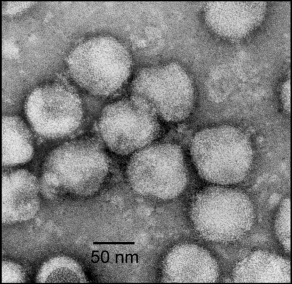
 Electron micrograph of negatively stained NDiV virions

Members of this family are enveloped, spherical in shape and 60–80 nm in diameter with club-shaped surface spikes. There are eight major structural proteins, including a nucleocapsid protein (25 kDa in weight), four differentially glycosylated forms of the membrane protein (20, 19, 18 and 17 kDa) and the spike (S) protein (77 kDa), which is cleaved to produce two S protein subunits (23 and 57 kDa).[5][7]
The genomes are linear, positive-sense, polycistronic, single-stranded RNA, and are about 20,000 nucleotides in length, with a 3' poly(A) tail and seven major open reading frames (ORFs). Two overlapping ORFs are at the 5'-end, encoding the major non-structural proteins and are expressed as a fusion protein by ribosomal frameshift. ORFs 1a and 1b contain six replicase domains, as well as the 3'-5' exoribonuclease (ExoN) that controls RNA replication fidelity and a 2'-O-methyltransferase, both of which are found in larger nidoviruses. ORF 1b also encodes an N7-methyltransferase.[2][7]

History

The family is relatively new, having only been discovered in 2011. The first virus, which was named Nam Dinh virus, was found in the Vietnamese province of Nam Định.[2] The second virus, named Cavally virus, was then found in Côte d'Ivoire.[7] These two viruses were later found to be of the same species. A third member of this first species, named Dak Nong virus, was later found in Culex tritaeniorhynchus populations in Vietnam.[8] In 2013, four more mesoniviruses were discovered in mosquito populations, all within Côte d'Ivoire,[5] and in 2014 four mesoniviruses were discovered in mosquito populations in Australia,[6] Indonesia, and Thailand.[3]


unranked): Virus
Realm: Riboviria
Phylum: incertae sedis
Order: Nidovirales
Suborders and Families[1]


Electron micrograph of negatively stained NDiV virions
Virus classification e
(unranked): Virus
Realm: Riboviria
Phylum: incertae sedis
Order: Nidovirales
Suborder: Mesnidovirineae
Family: Mesoniviridae
Subfamily: Hexponivirinae
Genus: Alphamesonivirus
Subgenera and Species

NIDOVIRALES 2006 . Coronaviruses, Toroviruses, Roniviruses, Arteriviruses

http://www.ncbi.nlm.nih.gov/pubmed/16503362

Virus Res. 2006 Apr;117(1):17-37. Epub 2006 Feb 28. Nidovirales: evolving the largest RNA virus genome.
Molecular Virology Laboratory, Department of Medical Microbiology, Leiden University Medical Center, LUMC E4-P, P.O. Box 9600, 2300 RC Leiden, The Netherlands.

TIIVISTELMÄ (Abstract)

Katsaus  kohdistuu monofyleettiseen eläinRNA-virus ryhmään,  NIDOVIRALES

  • Tämä käsittää kaukaisesti toistensa sukuiset coronavirukset  (Coronaviruses) torovirukset (Toroviruses)  ja ronivirukset (Roniviruses), joilla  on   suurin tunnettu RNA- genomi ( 26- 32 kb) ja  sen takia niitä sanotaan isoiksi nidoviruksiksi. Niitä vertaillaan niitten "serkkuihin", arteriviruksiin (Arteriviruses), jotka myös kuuluvat  NIDOVIRALES -viruksiin, vaikka niillä on  paljon pienempi genomi (13- 16 kb) .

This review focuses on the monophyletic group of animal RNA viruses united in the order Nidovirales. The order includes the distantly related coronaviruses, toroviruses, and roniviruses, which possess the largest known RNA genomes (from 26 to 32kb) and will therefore be called "large" nidoviruses in this review. They are compared with their arterivirus cousins, which also belong to the Nidovirales despite having a much smaller genome (13-16kb). 
  •  Otsikon artikkeli kuvaa yleisiä ja ainutlaatuisia piirteitä, joita nöissä  isoissa tai kaikissakin nidoviruksissa on tunnistettavissa, kuten  nidovirusten geneettinen ohjelma ja genomin diversiteetti, replikaasikoneiston  ja viruspartikkelien koostumus, viruksen spesifiset lisägeenit, RNA ja proteiinisynteesin mekanismit, pieni- ja isogenomisten nidovirusten alkulähde ja evoluutio. 
Common and unique features that have been identified for either large or all nidoviruses are outlined. These include the nidovirus genetic plan and genome diversity, the composition of the replicase machinery and virus particles, virus-specific accessory genes, the mechanisms of RNA and protein synthesis, and the origin and evolution of nidoviruses with small and large genomes. 
  •  Nidoviruksilla on yksisäikeiset,  polaarisuudeltaan positiiviset  polycistroniset RNA genomit, jotka ohjaavat replikatiivisen kompleksin alayksiköiden, kuten RNA.sta riippuvan RNApolymeraasin ja helikaasin  synteesin. 
Nidoviruses employ single-stranded, polycistronic RNA genomes of positive polarity that direct the synthesis of the subunits of the replicative complex, including the RNA-dependent RNA polymerase and helicase.
  •  Replikaasigeenin ilmenemää  kontrolloi  ylimpänä  ribosomaalinen ohjelmaa vaihtava signaali ja kymotrypsiinin kaltainen proteaasi, jota avustaa yksi tai useampi papaiinin tapainen proteaasi. 
 Replicase gene expression is under the principal control of a ribosomal frameshifting signal and a chymotrypsin-like protease, which is assisted by one or more papain-like proteases.

  •  Subgenominen  RNA-settisarja syntetisoituu ilmentämään 3´ORF:eja  ( open readign frames),  jotka koodaavat useimmat konservoidut rakenteelliset proteiinit ja joissain isoissa nidoviruksissa myös erilaisia lisäproteiineja, jotka saattavat edistää viruksen adaptoitumista  spesifisiin isäntiin. 
A nested set of subgenomic RNAs is synthesized to express the 3'-proximal ORFs that encode most conserved structural proteins and, in some large nidoviruses, also diverse accessory proteins that may promote virus adaptation to specific hosts.
  •  Replikaasikoneisto käsittää  setin RNA:ta prosessoivia entsyymeitä, joissa jotkut ovat jollekin tai kaikille isoille nidoviruksille ainutlaatuisia. Tällaisten entsyymien hankkiminen lienee parantanut RNA-replikaation vähemmän uskollista  toistamista sallien genomin expansion  ja tuottaa  jatkossa esiviruksia niin pienille kuin suurille nidoviruksille. 
The replicase machinery includes a set of RNA-processing enzymes some of which are unique for either all or large nidoviruses. The acquisition of these enzymes may have improved the low fidelity of RNA replication to allow genome expansion and give rise to the ancestors of small and, subsequently, large nidoviruses.
 
(Huomt. Torovirukset katsotaan NIDOVIRALES lahkossa  Coronavirusten alaperheeksi Wikipedialähteen mukaan) :