Leta i den här bloggen

Visar inlägg med etikett integraasi. Visa alla inlägg

lördag 24 december 2011

HIV-1 integraasin endonukleaasi aktiivisuus

HIV-1 integrase reveals critical regions for protein–DNA interaction

Dominic Esposito1 and Robert Craigie1

  1. Laboratory of Molecular Biology, NIDDK, National Institutes of Health, 5 Center Drive MSC0560, Bethesda, MD 20892, USA

Correspondence to:

Robert Craigie, E-mail: bobc@helix.nih.gov

Received 6 July 1998; Accepted 5 August 1998; Revised 29 July 1998

  • HIV-1 integraasi tunnistaa ja pilkkoo viruksen DNA:n päädyn alkuaskelena integaatioprosessiin.

HIV-1 integrase specifically recognizes and cleaves viral end DNA during the initial step of retroviral integration.

  • Mitkä seikat proteiinissa ja DNA:ssa määräävät tämän spesifisen sitoutumisen viruksen päättyyn?

The protein and DNA determinants of the specificity of viral end DNA binding have not been clearly identified.

  • Asiaa tutkitaan: Analuysoidaan viruksen DNApäädyn LTR-sekvenssi ja sen interaktiot integraasiin.

We have used mutational analysis of the viral end LTR sequence, in vitro selection of optimal viral end sequences, and specific photocrosslinking to identify regions of integrase that interact with specific bases in the LTR termini.

  • Integraasin CCD jakson ( integraasin ydindomaanin) epäjärjestäytynyt silmukka erityisesti aminohapot Q148 ja Y143 osallistuvat sitoutumalla viruksen DNA:n päätyyn.

The results highlight the involvement of the disordered loop of the integrase core domain, specifically residues Q148 and Y143, in binding to the terminal portion of the viral DNA ends.

  • Lisäksi löytyy v ds DNA.ssa ylävirtaan sijaitsevana LTR-päädyssä integraasin C-terminaalisen domaanin kanssa interaktiossa olevia asemia jotka stabiloivat viruksen DNA:n sitoutumista.

Additionally, we have identified positions upstream in the LTR termini which interact with the C-terminal domain of integrase, providing evidence for the role of that domain in stabilization of viral DNA binding.

  • Lisäksi havaitaan 12 emästä DNA-päädystä laskien sijaitseva alue, joka on essentielli DNA:n sitoutumisessa magnesiumin (Mg++) läsnäollessa mutta ei manganeesin (Mn++) läsnäollsessa, viitaten eri divalenttien kationien merkityksesn sekvenssispesifisessä sitoutumisessa.

Finally, we have located a region centered 12 bases from the viral DNA terminus which appears essential for viral end DNA binding in the presence of magnesium, but not in the presence of manganese, suggesting a differential effect of divalent cations on sequence-specific binding.

  • Nämäkin tulokset auttavat määrittämään tärkeitä alueita integraasin(IN) ja virusDNA: n välisessä kontaktissa ja avustavat hahmottamaan tämän vitaalin interaktion molekulaarista kaavaa.

These results help to define important regions of contact between integrase and viral DNA, and assist in the formulation of a molecular model of this vital interaction.


Paul Spearmanin kirjassa kerrotaan tarkasti eri retrovirusten tärkeistä sekvenseistä kuten HIV-1 integraasista seuraavaa sivulla 134:

Aminohapot 90- 190 ovat seuraavia
90 PAETG QETAYF ( osaa alfa1helixiä)
100 LLKL AGRWPV (osa alfa-1 helixiä)
110 KTVH T DNGSN
120 FTSTT VKAAS ( alfa2 helixiä)(osaa alfa3 helixiä)
130 WWAGI KQEFGI ( osaa alfa 3-helixiä)
140 PYNPQ SQGVI (osaa alfa4 helixiä)
150 ESMNK ELKKI(alfa4 helixiä)
160IGQVR DQAEH (osaa alfa 4 helixiä) (alfa 4/5 connectorpeptidi)
170 LKTAV QMAVF (osaa alfa 5 helixiä)
180 IHNFKRKGG (osaa alfa 5 helixiä)
190
Kaikilla viruksilla HIV, SIV, FIV, BIV, EIAV on alfa1-helixissä samassa asemassa leusiini(L).
Samoin aspasrtaatti (D) alfahelixien 1 ja 2 välillä. ( Tämän jälkeen on yksi katalyyttinen keskus N)
Alfa3 sekvenssi on kaikilla melko erilainen: HIV-1 viruksella: TVKAASWWA
Aminohappo 150E on taas kaikissa sama. (Tämän jälkeen on toinen katalyyttinen keskus M)
Alfa4/5 konnektoripeptidi on suhteellisen erilainen kaikilla.
HIV-1 alfa4/5 konnektoripeptidi on jaksolla DQAEHLKTAVQMA

Katalyyttiset keskukset eivät käy kontaktiin IBD-pinnan kanssa.


Integraasin pitää ainakin dimerisoitua, jotta se voi koeputkessa tehdä 3´päädyn prosessoinnin, trimmauksen. Mutta tetrameeri vaaditaan DNA säikeen siirtoon. Isompiakin multimeerejä on havaittu HIV-2 viruksen yhteydessä. Mikä relevanssi oligomeerisella tilalla on?

Muistettava HAART terapian nykyarsenaali:

Classes of drugs

Antiretroviral (ARV) drugs are broadly classified by the phase of the retrovirus life-cycle that the drug inhibits.

  • Entry inhibitors (or fusion inhibitors) interfere with binding, fusion and entry of HIV-1 to the host cell by blocking one of several targets. Maraviroc and enfuvirtide are the two currently available agents in this class.
  • CCR5 receptor antagonists are the first antiretroviral drugs which do not target the virus directly. Instead, they bind to the CCR5 receptor on the surface of the T-Cell and block viral attachment to the cell. Most strains of HIV attach to T-Cells using the CCR5 receptor. If HIV cannot attach to the cell, it cannot gain entry to replicate.
  • Non-Nucleoside and nucleotide reverse transcriptase inhibitors (NNRTI) inhibit reverse transcription by being incorporated into the newly synthesized viral DNA strand as a faulty nucleotide. This causes a chemical reaction resulting in DNA chain termination.
  • Nucleoside reverse transcriptase inhibitors (NRTI) mimic nucleotides and inhibit reverse transcriptase directly by binding to the enzymes polymerase site and interfering with its function.
  • Protease inhibitors (PIs) target viral assembly by inhibiting the activity of protease, an enzyme used by HIV to cleave nascent proteins for the final assembly of new virions.
  • Integrase inhibitors inhibit the enzyme integrase, which is responsible for integration of viral DNA into the DNA of the infected cell. There are several integrase inhibitors currently under clinical trial, and raltegravir became the first to receive FDA approval in October 2007.
  • Maturation inhibitors inhibit the last step in gag processing in which the viral capsid polyprotein is cleaved, thereby blocking the conversion of the polyprotein into the mature capsid protein (p24). Because these viral particles have a defective core, the virions released consist mainly of non-infectious particles. Alpha interferon is a currently available agent in this class.[2] Two additional inhibitors under investigation are bevirimat [3] and Vivecon.


fredag 23 december 2011

Viruksen integraasi ja sen eston periaate

http://www.fccc.edu/research/pid/skalka/research.html

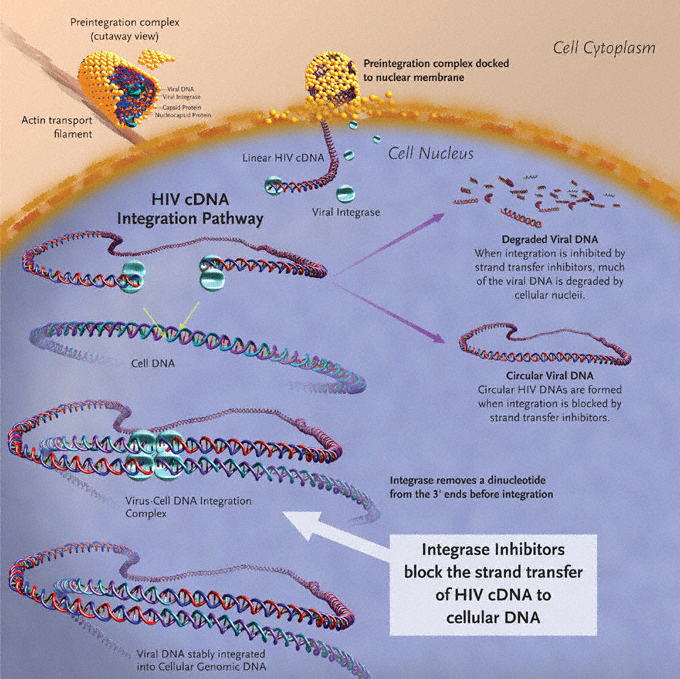
Vuodesta 2008 on ollut integraasin estolääkettä olemassa. Periaate on selvitetty alla olevassa kuvassa. Jos integraasia ei ole saatavilla HIV viruksen cDNA genomi ei voi tehdä provirusta ihmisen genomiin vaan hajoaa.

http://www.prn.org/images/uploads/478_integrase_fig1.jpg
  • Onnistunut HAART hoito voi oikein hyvin vaimentaa HIV-1 viruksen replikoitumisia ja kohentaa huomattavasti immuniteettia.

The successful use of highly active antiretroviral therapy (HAART) can dramatically suppress human immunodeficiency virus (HIV)-1 viral replication and effect significant immune reconstitution.

  • Mutta vaikka lääkkeitä olisikin hyvin saatavilla, lääkeresistenttien HIV-1 kantojen lisääntyminen ja lääketoksisuudet voivat suistuttaa hyvääkin hoitoa raiteilta.

However, despite full access to antiretroviral agents, the emergence of antiretroviral-resistant HIV-1 strains and/or drug toxicities can derail effective treatment.

  • Lääkeresistenssikin siirtyy viruksen levitessä ja viruskannoista vähintäin yhdelle lääkkeelle resistenttejä havaittiin 24.1 % eräässä newyorkilaiskohortissa, jossa oli akuuttia ja varhaisvaiheen HIV-1 infektiota.

A prospective study of patients in a New York City cohort with acute and early HIV-1 infection found the prevalence of transmitted resistance to at least one antiretroviral agent to be 24.1%.

  • On tarvetta kehittää uusilla toimintamekanismeilla vaikuttavia antiretroviruslääkkeitä, joilla voidaan hoitaa sekä antiretrovirus-lääkitystä ennen saaneita tai niitä jolla ei vielä ole ollut antirestroviruslääkitystä

Consequently, the need to develop antiretroviral agents with novel mechanisms of action persists for the treatment of both antiretroviral-experienced and antiretroviral-naïve patients.

  • FDA vuonna 2007 hyväksyi ensimmäisen integraasi-inhibiittoriluokan lääkkeen HIV-1 infketion hoitoon osana kombinoitua antiretrovirusterapiaa niillä, jotka jo aiemmin olivat saaneet antiretroviruslääkkeitä (indikaationa tehokas HIV/AIDS taudin hoito).

In October 2007, the United States Food and Drug Administration (FDA) approved the first drug in the integrase-inhibitor class for the treatment of HIV-1 as part of combination antiretroviral therapy in treatment-experienced patients, adding to the available chemotherapeutic agents for the effective treatment of HIV/AIDS.

  • HIV integraasista ja integraatiosta kertauksena:

HIV Integrase and Integration

  • Tiedetään, että HIV-1 viruksen replikaation onnistuminen vaatii kolme entsyymiä
(1) käänteiskopioitsijan Reverse Transcripotase (RT)
(2) integraasin (IN)
ja (3) proteaasin.

Successful HIV-1 replication requires the use of 3 enzymes: reverse transcriptase, integrase, and protease.

  • HIV-1 viruksen elämänsykli alkaa viruksen sisäänmenosta (ENTRY) sellaiseen isäntäsoluun, jolla on pintamolekyyli CD4.

The HIV-1 life cycle initiates with viral entry into host immune cells that express surface CD4.

  • Viruksen ENTRY-tapahtuman jälkeen HIV-1 entsyymi Reverse transkriptase (RT) käänteiskopioi viruksen tuoman yksinkertaisen RNA- säiemateriaalin kaksinkertaiseksi, dsDNA materiaaliksi, missä vaiheessa integraasiproteiinia (IN) kokoontuu stabiiliksi kompleksiksi virus DNA:n kanssa ja sitä sanotaan preintegraatiokompleksiksi (PIC), joka menee tarkalla kaitsennalla (chaperone) tumaan.

After viral entry, HIV-1 reverse transcriptase converts its single-stranded RNA into double-stranded DNA (dsDNA), at which time integrase assembles in a stable complex with viral DNA—the pre-integration complex—and is chaperoned into the nucleus.

  • Integraasi toimii kaksivaiheisesti: tuloksena on HIV-1 komplementaarisen DNA:n integraatio isäntäsolun genomiin kahdessa vaiheessa, joita katalysoi viruksen HIV-1 integraasientsyymi.

Subsequent integration of HIV-1–complementary DNA (cDNA) into the host genome is a two-step process catalyzed by the HIV-1 integrase enzyme.

  • (Ensimmäinen vaihe) Jo sytoplasmassa, heti käänteiskopioinnin jälkeen viruksen tuoreesta cDNA:sta leikkaa intengraasientsyymi irti dinukleotidin ( 2 nukleotidiä) 3´-päädystä.
  • (Tämä tapahtuu vaikka LEDGF/p75 ei olisi läsnä. (Soluissa LEDGF /p75 assosioituu IN tetrameerin kanssa. IBD stabilisoi integraasin alayksikkö-alayksikkö-interaktioilla edistäen tetrameerin muodostumista, 2008)

Initially, 2 nucleotides are excised from the 3´ ends of the nascent HIV-1 DNA.

  • (Toinen vaihe, strand transfer) Tuman puolella seuraa palautumaton, kovalentti viruksen genomisen DNA:n istuttaminen isäntäsolun tarjoutuvaan kromosomiin.
  • (Strand transfer onnistuu hyvin kun IN on tetrameerinä. LEDGF/p75 indusoi viruksen integraasiin järjestäytyneisyyttä ja täten ehkä parempaa entsymaattista aktiivisuutta)

This is followed by the irreversible, covalent insertion of HIV-1 viral genomic DNA into the host chromosome.

  • Tiedetään HIV-1 viruksen integroituvan suosimalla tiettyjä Hot Spots kohteita transkriboiduissa isäntägeeneissa, mutta näitten suosituimmuuksien taustaa ei ole täysin selvitetty.

While the HIV-1 virus is known to preferentially target sites within transcribed host genes for integration—so called “hot spots”—the factors underlying these preferences are not entirely clear.

  • Kun integraasi inhiboidaan, isäntäperäiset entsyymit tekevät viruksen cDNA:n renkaaksi ja 2-LTR ( long terminal repeats) renkaita kertyy tuman sisälle.

When integrase is inhibited, host enzymes circularize the viral cDNA, and 2-long terminal repeat (LTR) circles accumulate in the nucleus.

  • Kun estetään integraasia tekemästä essentiellejä funktioitaan, blokeerataan HIV-1 DNA:n stabiili integroituminen isäntägenomiin ja estetään viruksen latenssin kehittyminen isäntäsolun sisässä, mikä estää vahva-asteista HIV-1 replikoitumista ja uusien viruksien infektoitumista infektioimiskykyisellä virionilla.

Inhibiting integrase from performing its essential functions therefore blocks stable integration of HIV-1 DNA into the host genome and prohibits the establishment of viral latency within the host cell, preventing high-level HIV-1 replication and infection of new cells by competent virus.

(Tässä vielä maininta: On edelleen epäselvää, missä endogeeninen LEDGF/p75 ensimmäisen kerran joutuu kosketuksiin viruskompleksin kanssa Tästä kirjoitan erikseen yksityiskohtia )


  • Kaksi kliinisesti relevanttia valmistetta Raltegravir ja Elvitegravir mainitaan Internetissä

Clinically Relevant CompoundsTop of page

Raltegravir (RAL, IsentressTM, formerly MK-0518)Top of page

Figure 2. The chemical structure of raltegravir.

Figure 2. The chemical structure of raltegravir.

Adapted with permission from Merck & Co., Inc.49

Raltegravir is a 1-N-alkyl-5-hydroxypyrimidinone. As such, it is a structural analogue of the di-keto acid class of compounds and shares their β-hydroxy-ketone structural motif (Figure 2).17,20,21 This structural motif possesses metal-chelating functions, and it is postulated that compounds bearing these functional groups interact with divalent metals within the active site of HIV-1 integrase.22–24 The insertion of HIV-1 viral genomic DNA into the host chromosome is a process often referred to as strand transfer.11,12 Raltegravir and its related molecules inhibit this latter step, and as a result are often referred to as “strand-transfer inhibitors.” The work of several authors provides an in-depth discussion of the chemical synthesis and screening of HIV-1 integrase inhibitors.25–27

Raltegravir has been shown to have a 50% inhibitory concentration (IC50) of approximately 10 nM.28 The results of 3 double-blind, randomized, placebo-controlled studies of raltegravir dosing demonstrate that raltegravir exhibits potent in-vitro activity and has an IC95 of 33 nM in 50% human serum.29 Raltegravir is active across diverse HIV-1 clinical isolates and has been shown to inhibit the in-vitro replication of HIV-2.28

Elvitegravir (EVG, GS-9137, JTK-303)Top of page


Figure 3. The chemical structure of elvitegravir

Figure 3. The chemical structure of elvitegravir.

Elvitegravir is a dihydroquinoline carboxylic acid compound that, like raltegravir, exhibits the active integrase-inhibitor–conferring β-hydroxy-ketone structural motif (Figure 3). Also, like raltegravir, elvitegravir is a specific inhibitor of the strand-transfer step of HIV integration.30 This drug is active against HIV-1 and HIV-2, has an IC90 of 1.2 nM in peripheral blood mononuclear cells (PBMCs), and a serum-free antiviral IC50 of 0.2 nM. As expected, elvitegravir has also demonstrated activity against isolates resistant to nucleoside reverse-transcriptase inhibitors (NRTIs), non-nucleoside reverse-transcriptase inhibitors (NNRTIs), and protease inhibitors (PIs).31

http://www.prn.org/index.php/management/article/integrase_inhibitors_raltegravir_elvitegravir_hiv_disease_478#subHeadFour

http://en.wikipedia.org/wiki/Elvitegravir

http://en.wikipedia.org/wiki/Raltegravir